
Sustainability
The sun now runs the factory floor
Food manufacturing runs on power. Over six weeks in early 2026, we worked with Sosimple Energy to put a solar array and battery system on our Lusaka factory — so that the lights, the cold rooms and the production lines answer to the sun first.
Roan Foods & Brands · Lusaka, Zambia
Most people picture a food factory in terms of what goes into the product — the tomatoes, the flour, the spice, the packaging. Inside the building there is one more input that never appears on a label, and without it nothing else matters.
Electricity.
Our cold rooms hold product at temperature around the clock. Our blast freezers, mixers, ovens and packing lines all draw hard on the supply. In a frozen and chilled foods business, a break in power is not an inconvenience — it is a break in the cold chain, and a break in the cold chain is a food safety question before it is ever a commercial one.
Like every manufacturer in Zambia, we have spent recent years planning around a national grid under real pressure. Load management became a production variable. Diesel filled the gaps, at a cost that climbed every year and burning fuel we would rather not burn.
At some point the question stopped being how do we cope and became how do we stop coping.
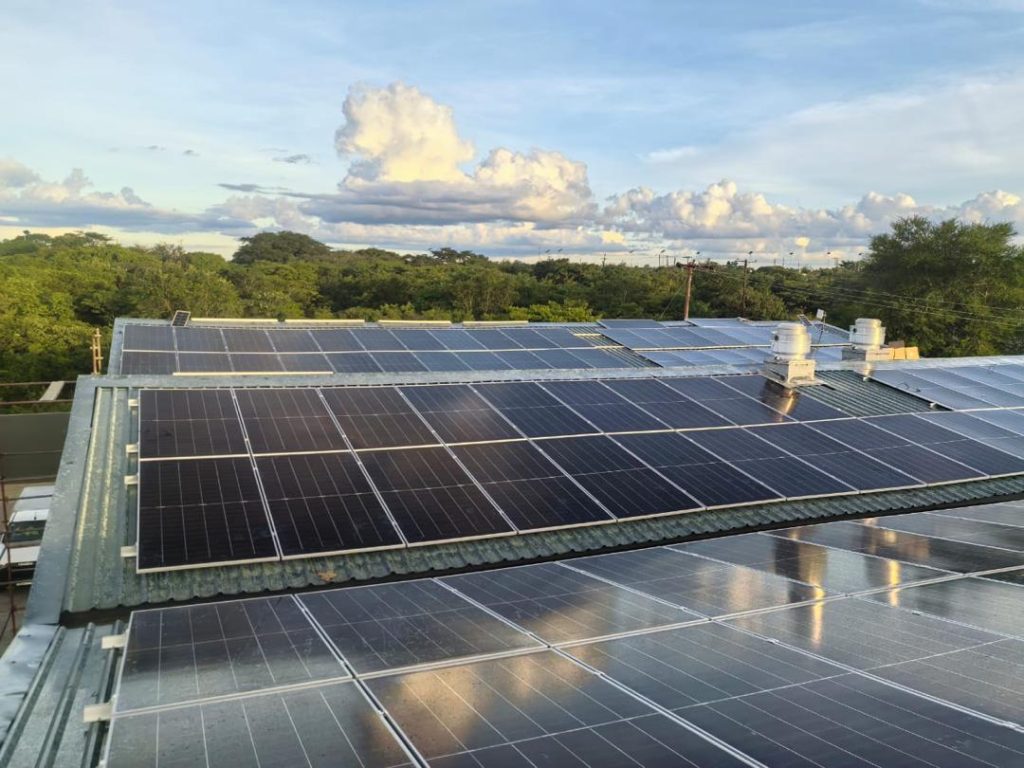
The completed rooftop array at our Lusaka facility.
Choosing a partner
We went looking for an energy partner who understood industrial loads rather than household rooftops, and who would stand behind the system long after the invoice was settled.
We found that in Sosimple Energy, who designed and installed the system at our Lusaka facility. Their engineering team travelled up from South Africa and spent six weeks on our roof and in our switch room.
Six weeks on the roof
The formal commencement notice came through on 20 February 2026. The installation team landed in Zambia on the Monday, and work began on site on Tuesday, 24 February. What followed is worth recording honestly — industrial projects are rarely the clean story the finished photograph suggests.
Week One — 24 February
Unglamorous and essential: site establishment, delivery of panels and batteries, and an engineering site visit to confirm what the drawings promised against what the roof actually offered.
Weeks Two and Three
Mounting structures went up across the roof. Panel installation began, inverters were mounted and configured, and the battery racks were installed and populated. Rain slowed the panel work more than once — the build ran through the tail of the rainy season, and a wet roof is a roof nobody works on.
Weeks Four and Five
The system came together: cable trays, earthing, DC cabling and the AC side of the installation.
20 March — 90 Per Cent
The installation stood at ninety per cent, waiting on a single part — the AC combiner box — before the system could be tied in and energised. A project of this size can still be held up by one component in transit.
1 April 2026 — Commissioned
Testing and commissioning completed. The system took up the load.

Mounting structures going up during the February–March installation.
What is on the roof
Solar Array
A rooftop photovoltaic array sized for industrial production load.
⚠ Content needed: system size in kWp, from the Sosimple commissioning pack.
Battery Storage
A battery energy storage system, so production does not stop when the sun does.
⚠ Content needed: storage capacity in kWh.
Electrical
Inverters, AC and DC protection, cable management and earthing to industrial standard.
Grid
A net metering arrangement with ZESCO, so the grid works alongside the system rather than against it.
What it changes
Solar and storage now carry our production load, with the grid sitting behind the system as backup rather than serving as our primary source. Three things follow from that.
Our cold chain got quieter
Temperature integrity no longer depends on a schedule published by somebody else. For a business supplying frozen and chilled product into national retail, that is the whole ballgame.
Our costs got more predictable
Sunlight does not send a revised tariff. For a manufacturer planning capacity and pricing years out, replacing a volatile input with a fixed one changes how confidently we can commit.
Our footprint got smaller
Every kilowatt-hour we generate on our own roof is a kilowatt-hour not burned in a diesel generator. Our retail and export partners are asking harder questions about the environmental profile of their supply chains, and we would rather have the answer installed than promised.
The next step
Carrying the load is not the same as independence. The goal we are working toward is a factory that runs entirely on what it generates and stores, with the grid as a formality rather than a fallback.
⚠ Content needed: this quote wording is a draft — confirm with Simon before publishing.
“We did not do this to make a statement. We did it because a food business that cannot guarantee its own power cannot guarantee anything else.”
Simon Bowa · Founder & CEO, Roan Foods & Brands
Build with us
We are always interested in partners who take the long view on infrastructure, sustainability and local manufacturing capacity.